

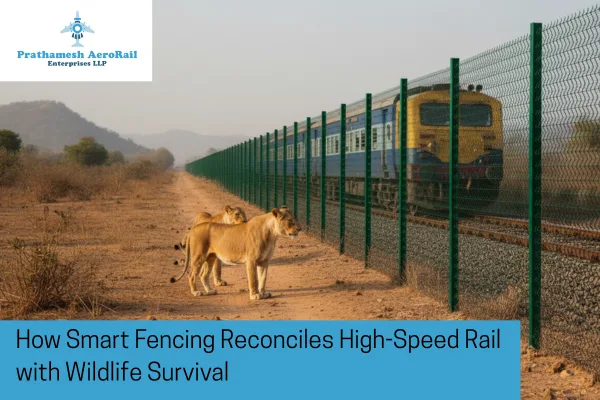
17 Oct How Smart Fencing Reconciles High-Speed Rail with Wildlife Survival
Fatal collisions between trains and animals aren’t random accidents. They’re symptoms of a deeper problem: rail infrastructure cutting through habitats and grazing lands without safe passageways.
For years, the default solution has been simple fencing. Put up a barrier and walk away. But here’s the thing: static fences don’t adapt. They stop animals from crossing, but they also block migration routes, water access, and grazing grounds. They solve one issue while quietly creating another. From a conservation and community perspective, that’s a failure disguised as progress.
Why “Good Enough” Fencing Fails
The reality on the ground proves it:
- In West Bengal, three elephants—including a calf—were killed while crossing a busy track. Alerts were shared, but human coordination failed.
- In Uttarakhand, a tiger was struck near Rajaji National Park. Fencing was there, but it didn’t guide or protect the animal.
- In Assam, four elephants died together when a herd attempted to cross a rail corridor that split their migration path.
- Cows are among the most frequent victims. In Gujarat, a train hit more than a dozen cattle in one incident. Across the country, stray cows regularly wander onto tracks, causing collisions, delays, and even derailments.
- Smaller animals like leopards, deer, and jackals are killed every month, though many of these cases never make headlines.
All these examples underline one truth: relying on partial barriers, speed restrictions, or last-minute human warnings doesn’t work. In a high-speed rail system, “good enough” fencing is costing lives.
A Smart Approach to Railway Safety
If we want railways that protect both trains and animals, we need more than static barriers. We need Nexus fencing: a system that combines strength with intelligence.
Here’s what that looks like:
- Stronger foundations: Nexus fencing uses welded mesh that can withstand both human intrusion and animal pressure.
- Safe deterrence: Integrated electric deterrent wires deliver non-lethal shocks. Cows, elephants, and other animals learn to avoid the fence without being harmed.
- Intrusion detection: Sensors built into Nexus fencing detect when large animals or cattle press against it. The system sends real-time alerts to control rooms and train drivers. That’s the difference between another accident and a safe outcome.
- Managed crossings: Nexus fencing is not about total exclusion. It works with monitored crossings, ensuring wildlife and cattle can move safely where it matters most.
Engineered for Coexistence: The Proof
The difference is immediate. In Assam, a monitored stretch of railway detected a herd of 60 elephants. An alert went out automatically. The train stopped in time. Sixty elephants crossed safely.
Compare that with the three deaths in West Bengal where the system depended on a WhatsApp message that didn’t reach fast enough. One approach fails, the other saves lives.
Why It Matters
India’s railways will only expand, and high-speed trains will cut through more forests, grasslands, and grazing areas. Elephants, tigers, leopards, deer, and cattle will keep crossing these corridors. Ignoring this reality only guarantees more tragedies.
Nexus fencing provides a smarter answer. By combining strong barriers with humane deterrence, real-time detection, and controlled crossings, it makes coexistence possible. It reduces accidents, saves animal lives, and prevents costly train disruptions.
This isn’t about choosing between development and conservation. It’s about building smarter infrastructure. Nexus fencing shows us how to do it.
Linekdin Article: The Coexistence Nexus: How Smart Fencing Reconciles High-Speed Rail with Wildlife Survival
Introduction
Railways remain one of the most efficient modes of transport, but their expansion into biodiversity-rich regions has created a persistent conflict: high-speed trains intersecting with wildlife movement corridors. Fatal collisions involving elephants, leopards, deer, gaur, and other species are not isolated events. They are a structural problem that emerges when infrastructure fails to integrate ecological intelligence.
Conventional wildlife fencing has been the default mitigation method. While it reduces direct crossings, static barriers also fragment habitats, isolate populations, and block seasonal migrations. The outcome is clear: fencing alone is not enough.
The Stakes: Why Current Approaches Fail
Dependence on human coordination, manual warnings, or speed restrictions has repeatedly proven inadequate in preventing collisions. Recent incidents underscore the urgency:
- West Bengal: Three elephants, including a calf, killed despite warnings relayed via local message groups.
- Odisha (Keonjhar): A herd struck on a corridor even after alerts were issued to pilots.
- Assam (Jorhat): Four elephants killed by a freight train at night.
- Uttarakhand: Repeated deaths of leopards and deer along forest-rail interfaces.
- Maharashtra (Tadoba): Indian bison (gaur) killed as tracks intersect buffer forest zones.
- Global parallels: Moose collisions in Norway and elk strikes in Canada demonstrate that this is a worldwide issue where railways cut across migration routes.
In every case, the underlying weakness is the same: reliance on outdated or reactive methods rather than integrated, real-time solutions.
The Nexus System: A Smart Alternative
The Nexus Fences System represents a shift from static barriers to intelligent railway-wildlife coexistence infrastructure. Its core components include:
- High-Security Mesh Infrastructure
- Ultra-tough welded wire mesh with anti-climb design.
- Provides baseline physical integrity against both wildlife and unauthorized human access.
- Electronic Deterrence
- Non-lethal electric deterrent wires integrated with the mesh.
- Delivers safe psychological conditioning for animals, ensuring avoidance without physical harm.
- Intrusion Detection Systems (IDS)
- Embedded vibration sensors or fiber-optic lines detect large animal contact in real time.
- Immediate alerts are relayed to control rooms and locomotive pilots, enabling timely operational responses.
- Hybrid and Managed Crossings
- Combining fencing with designated, monitored wildlife crossings.
- Ensures safe passage and maintains ecological connectivity while protecting the track.
Case Comparison: Failure vs. Success
- Failure: West Bengal, where human relayed warnings were too slow, leading to the death of three elephants.
- Success: Assam, where IDS installed along a high-conflict stretch detected a herd of 60 elephants. The system triggered an automated alert, trains halted, and all animals crossed safely.
The contrast highlights the impact of integrated intelligence. What separates a tragedy from a successful save is not chance, but planning and technology.
Implications for Policy and Infrastructure Design
Integrating smart fencing into railway projects offers multiple benefits:
- Ecological stability: Maintains wildlife corridors while preventing mortality.
- Operational reliability: Minimizes train delays caused by animal collisions.
- Asset protection: Reduces damage to locomotives and tracks.
- Public trust: Reinforces the railway sector’s role as a responsible infrastructure leader.
Conclusion: The Leadership Imperative
Building railways that coexist with ecosystems is no longer optional; it is a baseline responsibility. The Nexus Fences System demonstrates that technology can reconcile speed, safety, and survival when designed with foresight.
At Prathmesh Aerorail, we see this as more than a technical solution. It is a leadership commitment. Protecting wildlife while enabling transport efficiency is how infrastructure earns its legitimacy in the 21st century. The future of rail will not be measured only in kilometers built or trains launched, but in how responsibly we integrate them with the living landscapes they cross.
Linekdin Post content
🚆🌍 Railways and Wildlife: Time to Move Beyond “Good Enough”
Last month, three elephants—including a calf—were killed on a railway line in West Bengal. A few weeks earlier, four elephants died in Assam. In Uttarakhand, leopards and deer are struck with disturbing regularity. These are not isolated tragedies. They’re symptoms of a system that relies on outdated fences, delayed human alerts, and luck.
Here’s the truth: a static fence is no longer enough.
It might stop one accident but at the cost of fragmenting habitats and isolating populations. The result is predictable—more collisions, more ecological damage, and more public trust lost.
What changes the game is intelligence built into the barrier itself.
Smart fencing systems like the Nexus combine welded mesh, non-lethal deterrents, and intrusion detection sensors that can instantly alert railway control rooms when wildlife approaches. That’s the difference between losing a herd and saving sixty elephants in Assam.
At Prathmesh Aerorail, we believe future-ready infrastructure must coexist with ecosystems—not cut through them. Protecting wildlife while ensuring transport efficiency is not charity; it is smart planning, risk reduction, and leadership.
The question is no longer whether we can integrate coexistence into railway design. The question is: will we choose to?
