
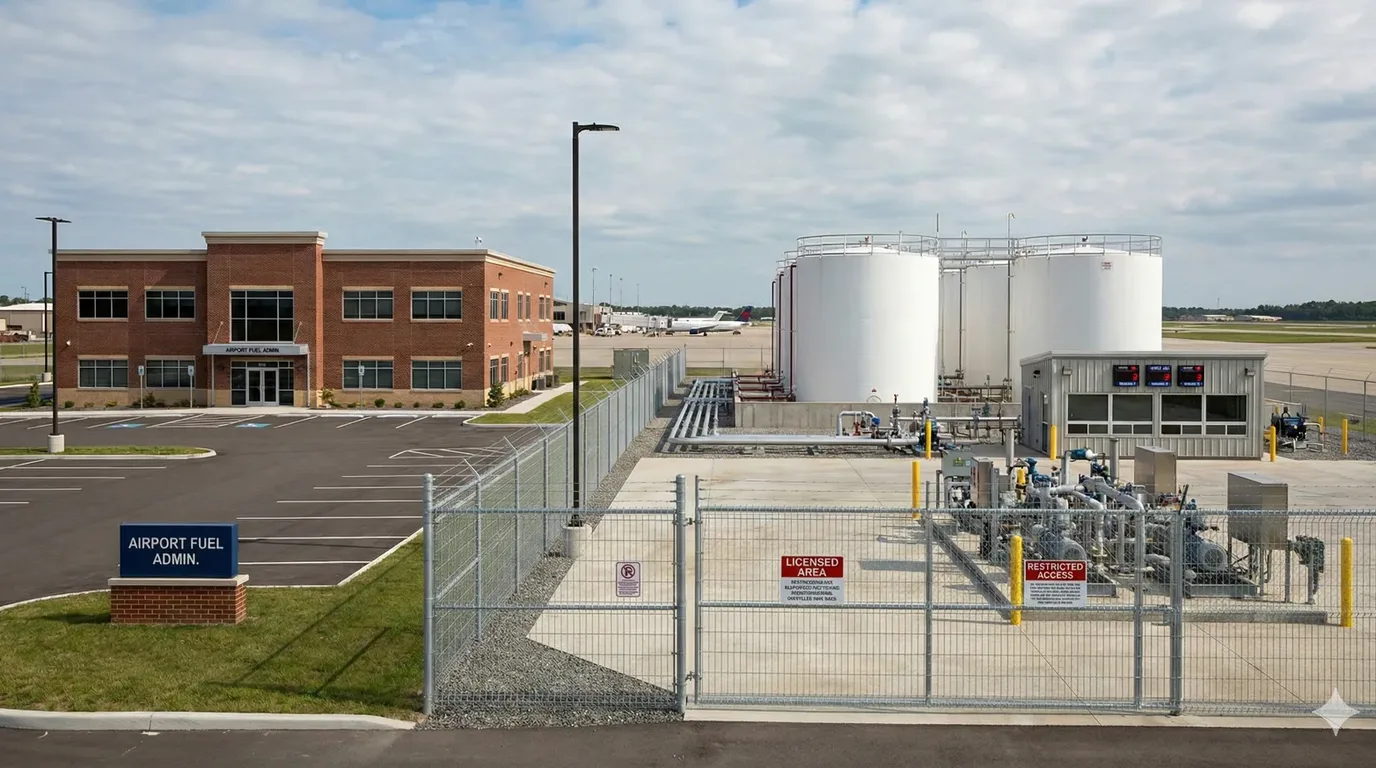
How perimeter fencing controls access at airports and power plants, and how AI-enabled radar and counter-drone technologies strengthen site protection.
Airports, data centres, power plants, refineries and industrial zones keep economies and daily life running. A disruption at any of them, whether from theft, sabotage or a deliberate attack, can have consequences far beyond the site. Protection starts at the boundary.
What a fence actually does
- Boundary definition: It marks where the protected area begins, removing ambiguity and making unauthorised entry unmistakable.
- Area demarcation: It separates public areas, restricted operational zones and high-security cores such as control rooms, substations or server halls, so access is granted only where needed.
- Access control: It funnels movement through gates, turnstiles and vehicle barriers where identity can be checked. Without a continuous boundary, gate checks mean little.
- Delay: It buys time between a breach attempt and reaching an asset, which detection systems and response teams need.
- Deterrence: A strong, well-maintained perimeter discourages opportunistic and planned intrusions alike.
Threats a perimeter addresses
A well-designed perimeter helps against theft and burglary of cable, fuel and equipment, forced or vehicle-borne entry, trespass and vandalism, and sabotage, where zoning limits how far an intruder can move. It also helps against hostile intrusion and terrorism at high-value sites. No fence stops a determined attacker alone. Its role is to make an attempt slower, harder and more visible, so the rest of the security system can respond.
The threat from above
Small, inexpensive drones are widely available, and recent conflicts have shown their use for reconnaissance, disruption and as weapons. They can map a site, carry contraband over a fence, interfere with airport operations or strike vulnerable points such as fuel storage and transformers. Perimeter thinking must now extend upward: airspace is part of the boundary.
Detection: radar meets AI
Drones are small and fly low, so they are hard to spot by eye or with conventional cameras. Compact radar can scan the airspace day and night, in poor light and bad weather. AI analyses the returns, including micro-Doppler signatures, to tell drones from birds or debris, which cuts false alarms. It can also flag suspicious behaviour, such as loitering near a sensitive asset. When fused with RF detectors and thermal or optical cameras, operators get one verified alert instead of several disconnected ones. Sensors can sit on fence-line posts and masts, so the perimeter that watches the ground can also watch the sky.
Neutralisation: EMP and directed energy
High-power microwave and EMP-type systems emit a focused burst that disrupts a drone's control, navigation and communication electronics. They act at the speed of the threat, can potentially counter several drones at once, and can be cued automatically by radar. They could be mounted on fence-line posts or masts, making neutralisation part of the perimeter structure.
The caveats matter:
- Regulation: In most countries, active disruption is restricted to authorised agencies.
- Collateral effects: Emissions can affect the site's own electronics and nearby aviation or communications.
- Uncontrolled descent: A disabled drone falls, which matters at a refinery or airport.
- Maturity: The technology is still evolving, so treat it as one layer, not a standalone solution.
A layered approach
The strongest protection combines a rigid fence for delay, ground sensors and cameras for intrusion detection, AI-enabled radar for the airspace, a unified control platform that shows operators the full picture, and authorised mitigation backed by defined response protocols.
The bottom line
A fence is the physical foundation of access control, zoning and delay, and it works best when paired with intelligent detection and, where legally permitted, counter-drone capability. Operators who plan the perimeter as a layered system that includes the airspace above will be better prepared for the threats of today and tomorrow.
For high-security perimeters, see Nexus Fortis anti-climb, anti-cut fencing and Nexus Indus-Shield for zoning inside industrial and aviation sites, or talk to the Nexus team about your site.