
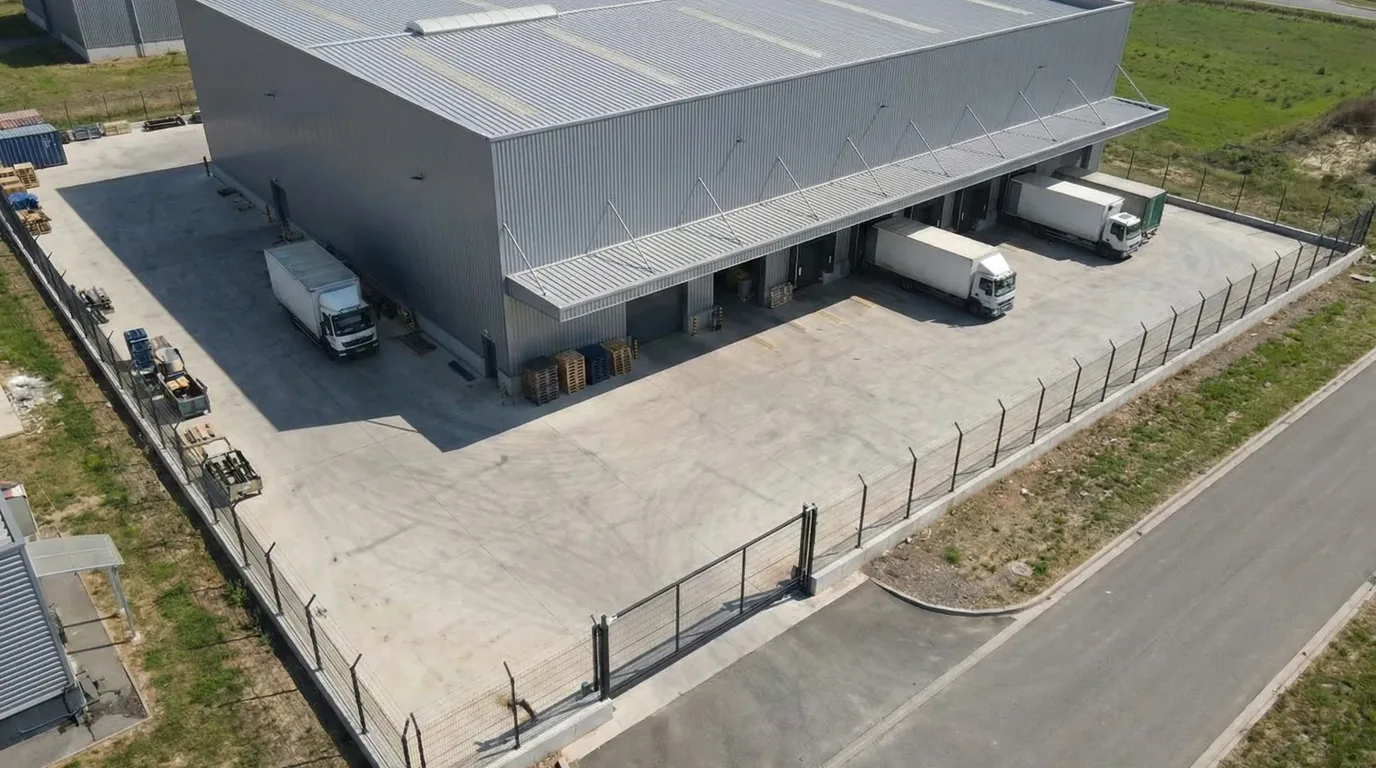
Why welded wire mesh outperforms chain link, how PIDS and layered security are reshaping perimeters, and why drones are the next challenge to plan for.
For decades, perimeter security meant a fence and a guard. Today the fence is only the first layer of a system that senses, verifies and responds. Here is where the industry is heading.
Welded wire mesh is replacing chain link
Chain link has been the default because it is cheap and familiar. But it was designed to mark a boundary, not to resist an intruder.
- Climb resistance: Chain link's diamond weave gives toe-holds and fingerholds. Welded mesh panels with narrow apertures, such as the 358 anti-climb pattern, leave almost nothing to grip.
- Cut resistance: Chain link can be snipped with basic hand tools, and the damage can spread. Thick, tightly spaced welded wires take much longer to cut, and a breach is easier to spot.
- Rigidity: Chain link stretches, sags and deforms over time. Welded panels hold their shape, which means fewer gaps and less maintenance.
- Visibility: Well-designed mesh still allows clear sightlines for cameras and patrols.
Rigid panels also suit sensor-equipped systems, since a stable structure gives more consistent and reliable readings.
The future is PIDS
Perimeter Intrusion Detection Systems (PIDS) change the question from "Can they get through?" to "Do we know the moment they try?" Common technologies include:
- Fence-mounted vibration or fibre-optic sensors that detect climbing and cutting
- Microwave and radar barriers that cover open ground
- Buried cable sensors for covert detection
- Thermal and video analytics that can tell a person from an animal or blowing debris
Modern systems can pinpoint an alert to a stretch of fence, which cuts response time and false alarms.
Security in layers
The strongest perimeters combine several layers, following the classic principle of deter, detect, delay, respond:
- Deter: Visible, robust fencing and signage
- Detect: Sensors on or around the fence
- Verify: Cameras and analytics that confirm an alert
- Delay: A physical barrier that is hard to breach and buys time
- Respond: Alerts to a control room, with lighting and access control working together
Physical and electronic systems now complement each other. The fence buys time and the electronics use that time, so each covers the other's weaknesses.
Drones: the new challenge
A fence works in two dimensions, but drones come from above. They can be used for surveillance, for smuggling contraband into facilities, or for scouting weaknesses before a ground breach. Prisons, energy sites, data centres, airports and industrial facilities are all exposed.
Perimeter planning now has to include airspace. That means drone detection through RF, radar and electro-optical or thermal sensors, tied into the same command-and-control platform as the ground systems. Counter-drone mitigation is heavily regulated in most countries, so detection and reporting are usually the practical first step, with any response handled in coordination with the authorities.
The bottom line
Effective perimeter security is no longer a single product. It is a designed system that combines strong physical barriers, intelligent detection and awareness of the air above. Facilities that plan for all three will be better protected than those relying on a fence alone.
Explore Nexus Fortis for anti-climb, anti-cut security and the full Nexus portfolio, or talk to the Nexus team about planning a layered perimeter.