
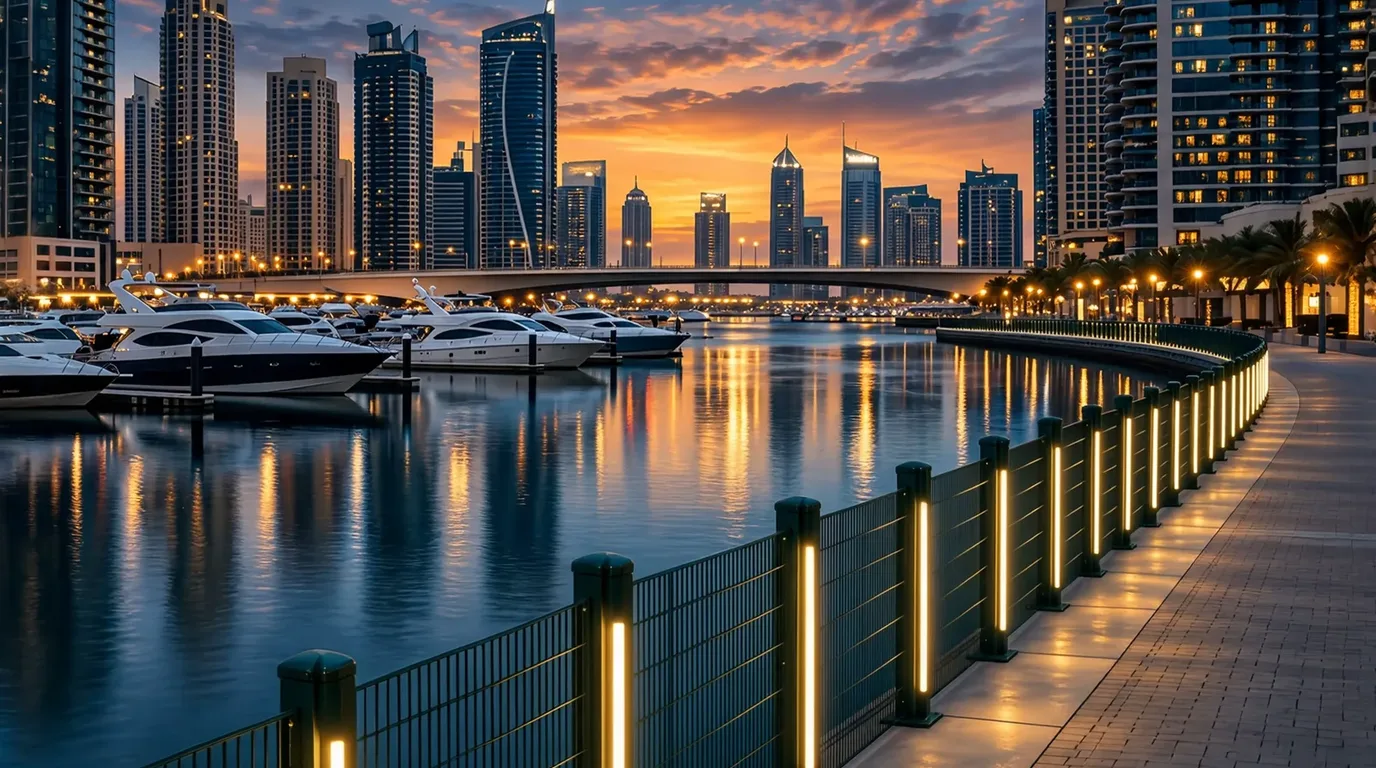
How modern fencing blends into the landscape, from solar-powered illuminated posts to clean, colour-finished mesh that protects without being an eyesore.
A fence used to be something you tolerated: a grey, utilitarian line between "ours" and "theirs." Today it is treated as part of the design, and the best systems protect a site while improving how it looks and feels.
From eyesore to design element
Several shifts made this possible:
- Cleaner profiles: Rigid welded mesh panels have crisp, uniform lines. Unlike sagging, uneven fabric, they look tidy from day one and stay that way.
- Colour and finish: Powder-coated finishes come in a wide palette, from classic black and anthracite to greens that recede into foliage or tones that match building facades. They also protect against corrosion, so the fence keeps its look over time.
- Transparency: Open mesh keeps sightlines clear, so a site feels open rather than walled in. This also supports natural surveillance, a principle behind Crime Prevention Through Environmental Design (CPTED).
- Landscape integration: Designers now plan fencing alongside planting, paving and lighting. Hedges, climbers and low shrubs soften the line, and gentle curves or stepped heights follow the terrain instead of fighting it.
The result is a boundary that reads as part of the architecture, whether it surrounds a corporate campus, a school, a residential community or a public park.
Illuminated posts: one element, many jobs
The post is where much of the innovation is happening. Modern illuminated posts do far more than hold up a panel:
- Ambient and safety lighting: Low-glare LEDs mark pathways, entrances and boundaries at night, making a site easier to navigate and more welcoming.
- Deterrence: Well-lit perimeters leave fewer places to hide and make suspicious activity easier to spot.
- Camera support: Consistent, even lighting along the fence line improves image quality for CCTV and video analytics.
- Housing for technology: Posts can carry cameras, sensors, intercoms or signage, keeping cabling tidy and hardware out of sight.
- Visual identity: Consistent lighting and post design give a site a distinctive, finished look after dark.
Solar-powered posts
Some illuminated posts now carry photovoltaic (PV) cells and a small battery. Solar panels charge during the day, and the LEDs run at night without a mains connection. The practical advantages include:
- Easier installation: No trenching or cabling is needed for lighting, which suits long boundaries, remote sites and retrofits.
- Lower running costs: Energy comes from daylight, and efficient LEDs draw little power.
- Resilience: Lighting keeps working during a grid outage.
- Sustainability: It reduces a site's energy footprint, which supports green building goals.
Performance depends on location, sunlight hours and battery capacity, so systems should be sized for local conditions. Where continuous high-power devices such as sensors or cameras are involved, a hybrid approach or a dedicated power supply is often the more dependable choice.
Balancing beauty and security
Good looks should never come at the cost of protection. A well-designed fence keeps the fundamentals: adequate height, climb and cut resistance, and a rigid structure. Aesthetics and security are not opposing goals. The same features that make a fence look clean, such as rigid panels, tight tolerances and quality coatings, also make it stronger and longer lasting.
The bottom line
Modern fencing shows that a perimeter can be secure, efficient and attractive at once. With smart, multifunctional posts, solar-powered lighting and design that works with the landscape, the fence is becoming one of the most thoughtfully designed parts of a site.
See Nexus Lumos, our integrated lighting and security fence, and the Nexus Fence range, or talk to the Nexus team about a boundary that suits your site.